
At 30 years old, the Hollywood Stock Exchange (HSX) bridges the different eras of prediction markets. Founded in 1995 during the dotcom bubble, HSX was only the second play-money prediction market. Later, it was acquired by Cantor Fitzgerald, which attempted to offer real-money box office futures via Cantor Futures, one of the early attempts to provide Commodity Futures Trading Commission (CFTC)-regulated event futures contracts outside of weather. Below, we’ll walk through HSX’s history and some of the lessons that can be learned today.
How HSX markets operate
HSX has branched out into diverse virtual financial products over the decades – Music Markets, Bollywood Stock Exchange, and TV Stocks – but we’re only going to briefly review a few of their most popular market types.
Instead of trading real money, HSX traders use a virtual currency called the “Hollywood Dollar” (H$). Early on the platform had a sweepstakes model where H$1million could be converted into $1 (USD). At some point in its early history, the cash prizes were dropped, and earning more virtual Hollywood Dollars and moving up the leaderboards was the sole reward for traders.
Here are some of the key markets offered on HSX:
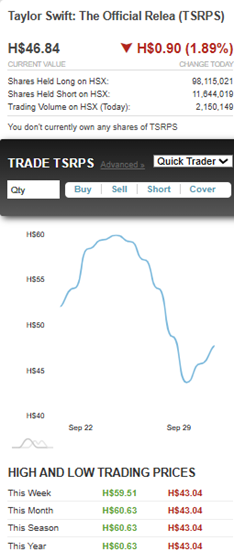
MovieStocks: These are stocks for the domestic North American box office of a specified film in its first four weeks of wide release. Shares are priced at 1/1,000,000 of the film’s actual box office. The market price of a MovieStock reflects how much money traders think the film will earn. For example, if a MovieStock for Taylor Swift’s upcoming “The Official Release Party of a Showgirl” is priced at H$48.64, the market believes the film will earn $48.64 million in its first four weeks.
StarBonds: A bond for a specific actor or director with film credits. The specific bond is priced for the actor or director’s average total box-office performance over their last five credited films by release date.
AwardOptions: Binary options contracts based on a special award event, such as Academy Award winners. Shares for the winner cash out at H$25, and the losing nominees are worth H$0.
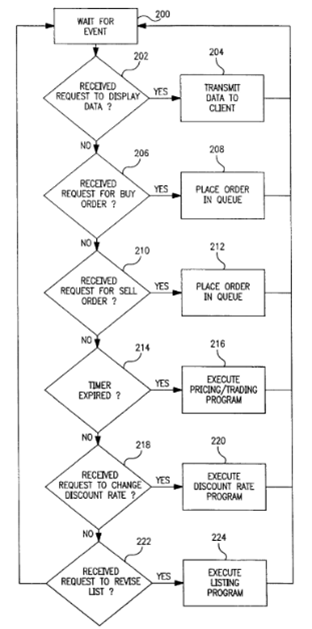
Trading is facilitated by HSX’s patented “Virtual Specialist”, which serves the same function as an Automated Market Maker (AMM) by simulating an orderbook. Whereas prices move along a fixed curve in an AMM, in the Virtual Specialist, HSX could manually tune the market’s parameters. In an October 2025 interview, former CEO Brian Dearth (2000-2002) describes HSX using price volatility to create uncertainty among traders, leading to greater engagement and more volume. “Periodically, we’d crash the market so people would pay attention,” he adds.
There was a central bank, called the “Hollywood Reserve,” to manage the value of the Hollywood Dollars and ratings of StarBonds. The Hollywood Reserve was managed by a “Dr. Zeros” (who was in real life was an HSX employee).
The Early Years
HSX founders were Max Keiser, a stockbroker and options trader, and Michael R. Burns, a managing director at Prudential Securities.

As with other dotcom-era companies, HSX first sought to generate revenue from advertising. But after a few years, “Michael Burns saw it as a data play, not an advertising play,” according to Brian Dearth. “We definitely pivoted to the traditional prediction market and data play. We wanted to be more than a single number…A subscription platform that studios could subscribe.”
And building a real-money exchange was always a long-term goal:
According to Max Keiser, who developed and launched the site for $300,000 along with fellow former trader Michael Burns, now vice chairman of Lionsgate, the HSX was created with the intention of being the first real-money exchange centered on box office performance.
However, after familiarizing themselves with the time, money and trouble needed to gain trading approval from the Commodity Futures Trading Commission, Keiser and Burns opted to keep it as a “virtual market.”
Along with the proliferation in box-office interest among the general public, the site’s popularity took off, souring to millions of registered users and hundreds of thousands of regular players.
HSX to Live On, Cantor Insider Says

Keisler and Burns were ambitious, and the site initially went well beyond trading box office futures with play money. Right off the bat, HSX produced original feature films, beginning in 1996 with “Mixed Signals” (aka “Atomic Highway”), where Michael Burns has a blink-and-you’ll-miss-it cameo (28:45 mark)
And the site initially looked to crowdsource financing for movies:
When HSX was launched in March, Burns told Daily Variety that he intended the site to be an entry point for Web surfers to get into film financing.
…
“Let’s say we have a million players around the world,” he said at the time. “We strike a deal with a filmmaker to raise $3 million with our game players. We tell our players they can put in $40 each, and effectively finance the movie.”
‘Highway’ pic listed on H’wood Stock Exchange
[HSX] plans to file each offering with the federal Securities and Exchange Commission and register in all 50 states – a process that lawyers estimate to cost around $100,000. “We’re working with the SEC to get the verbiage to make this viable,” explains HSX co-founder Max Keiser.
Film Financiers Undaunted by Destiny’s Fate
A great deal of money was spent promoting HSX. According to a tweet by Max Keiser, HSX was spending $100,000 per month for advertising on the Howard Stern show. The company also hosted several Oscars parties, first in 1999 (featuring Beck and Crystal Method) and again in 2000 (hosted by Rob Schneider, featuring Moby and Earth Wind & Fire). Rather than the typical dotcom era excess, former Manager of New Development Ben Curtis describes the Oscar parties as a strategic business decision by HSX:
In order to have the stars promote you, you needed to be useful to them…It needed to be some sort of positive marketing for them. It was very deliberately done…A very deliberate business decision. Part of doing it well was doing it outlandishly over the top.
Interview with Author, 10/10/2025
In the early days, HSX experimented with a variety of content creation. In 1999, they launched “HSX.tv” with original web programming aimed at traders, the weekly radio show “Buy, Sell, Hold” for KLSX , and Virtual Producer, “an immersive online experience that allows consumers to participate in every aspect of the production of a film.” Here is a segment of HSX.tv with Max Keiser:
The same year, Keiser began a weekly segment on NBC’s Access Hollywood called “Battle @ the Box Office,” where he would tell viewers box office estimates before the films were released.
Acting like he had been force-fed some of the Soma routinely dispensed to cohosts Nancy O’Dell and Pat O’Brien, Keiser dished out nothing but upbeat, cheery assessments of celebrity and film stocks “on the rise,” while repeatedly exhorting viewers to “buy Leelee Sobieski.”
‘Access’ Denied
In what would foreshadow later conflicts, the major studios objected to box office estimates being publicized before opening weekend and threatened to deny the TV show access to stars and footage after the very first episode. “Battle @ the Box Office” was quickly and quietly killed off.
HSX traders could accurately forecast box office
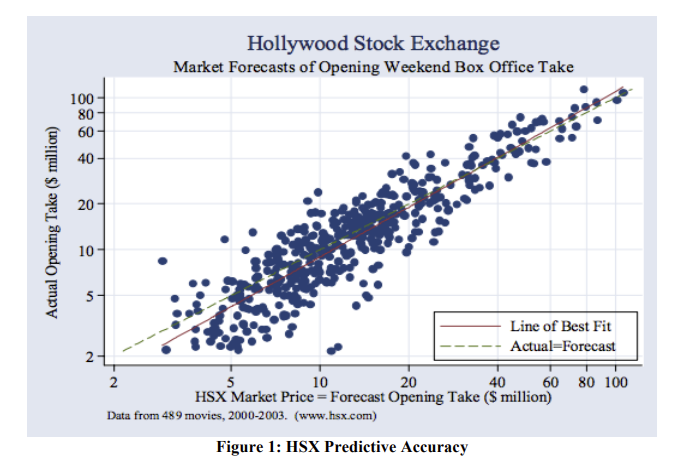
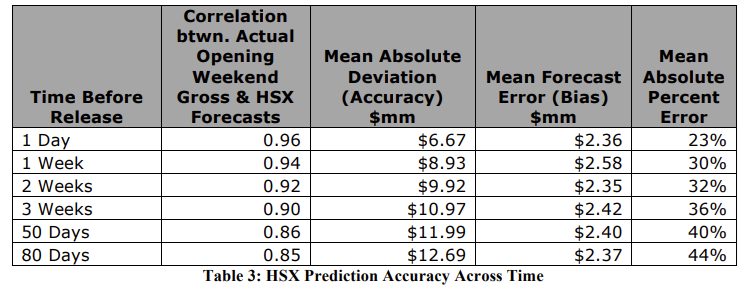
Despite using play money to trade, HSX markets were highly accurate predictors of movie box office. Over 12 years during their peak, HSX traders correctly predicted 82.1% of Oscar winners, while MovieStock prices were highly correlated (0.94) with the respective film’s actual box office receipts. It was trusted enough in Hollywood that studios such as MGM and Lionsgate were using HSX stock prices to inform their marketing decisions.
Opinions about HSX’s predictive potential often follow generational lines, said one midlevel manager at a major studio who did not want to be identified. Older executives, he said, often do not trust online data; younger ones tend to be more interested, but typically don’t make budget decisions.
This executive said he liked the HSX data because it gave an early indication of consumer interest. Stocks start trading on the exchange as soon as a studio gives a green light to a project, while market research typically begins less than four weeks before a film’s release. He said the HSX data had proved valuable in predicting box office receipts for blockbusters but had been less accurate for children’s films.
It’s Just a Game, but Hollywood Is Paying Attention
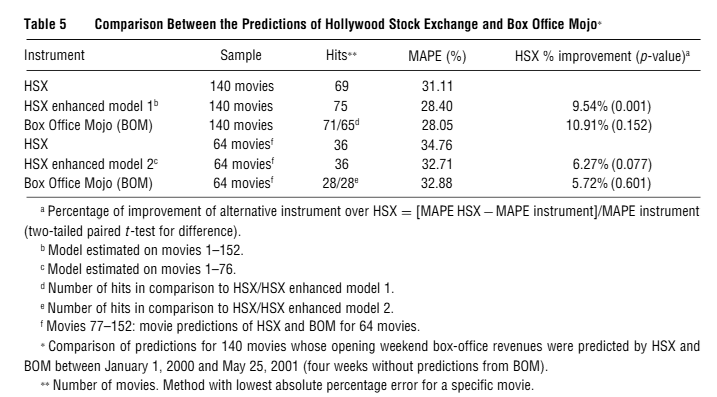
In 2003, German researchers Bernd Skiera and Martin Spann compared HSX prices with expert forecasts from Box Office Mojo (BOM) for 140 films. They also included some enhanced models to adjust HSX prices after noticing that HSX traders tend to underestimate large box office opening weekends and overestimate small openings. BOM performed slightly better than HSX overall, but found that adjusting for trader biases can make HSX slightly more accurate than BOM.
Benjamin Olsho compared HSX box office share prices with the actual four-week box office receipts among 98 films released from July 2011 to January 2013. Markets were highly correlated with the actual box office, even 80 days from opening weekend:
Building a vibrant trader community
Making their data accessible to traders was a key part of HSX’s community-building strategy.
“Giving away the data feeds the community that builds the data,” said Ben Curtis. At the time, everyone held their data so very close, [but HSX found] giving away something for free brings people in.”
Opening up HSX data was a flywheel to propel growth. Curtis describes the team as “being able to see real cases of information availability benefiting the whole system. Because the community has access to the information, they talk about it. Because they talk about it, they trade more. More people come on board.”
In the 2001 HSX Research report, there were over 725K registered users and 15,000 daily active users making 35,000 trades per day. HSX would hit its 1 millionth trader a few years later.
At that time, Americans dominated the site with 65% of all traders, but HSX drew traders from over 100 countries around the world. Unsurprisingly, the site attracted movie buffs: 15% of traders attended a movie at least once per week and 75% once per month, with 90% attended a movie in the past 3 months (when the US average was 60%).
The gender ratio was shockingly balanced for a prediction market; 40% of all active users were female on HSX in 2001, while Kalshi traders are only 10% as of October 2024. A longtime HSX trader familiar with the data noted in an October 2025 interview that the gender diversity came from HSX marketing targeting female traders and from the diversity of market types. Women were disproportionately interested in the StarBonds, centered around a famous actor or actress.
As for the success of the three decades of loyalty from the HSX trading community, the longtime trader added, “People have a love affair and fascination with movies…They want to be involved in the process, and [HSX] makes them feel part of the process…You own a little piece of the movie, the actors…You want them to succeed.”
Sale to Cantor Fitzgerald
As was typical for startups of that era, HSX burned through a great deal of money. After the initial $300,000 investment, there was a 1998 round of venture capital raised from Keystone Venture Capital. The next year, a second round of capital was raised from Citigroup Ventures, NBC, and XL Ventures. In 2000, HSX merged with Predict It (not the “PredictIt” political prediction market), bringing in a $10 million cash infusion from SBS Broadcasting SA, Citigroup Investments Inc., Dawntreader Fund I LP, Robert H. Lessin, Verus International, Keystone Venture Capital, Commonwealth Associates, Genesys Angelbridge Fund, and Hollywood Stock Exchange co-founders Michael Burns and Max Keiser.
But despite a large and engaged online community and accurate box office forecasts, HSX still wasn’t generating enough revenue from ads, sponsors, and market research.
In May 2001, HSX was sold outright to Cantor Index Holdings, a London-based unit of Cantor Fitzgerald, in a deal opposed by co-founder Max Keiser. Keiser would state, “I did not endorse the sale of HSX to Cantor – I voted against it – because the deal with Cantor was not, in my opinion, above board.” Years later Keiser would be even more blunt:
Doesn't #Lionsgate feel like assholes for giving away a 100 mn. dollar business (HSX) as a way to cover accounting fraud by management?
— Max Keiser (@maxkeiser) January 17, 2012
Shortly thereafter, Cantor introduced “spread betting” for film box office on Cantor Index in the U.K., using HSX data to set the initial prices:
A bookmaker creates a bet by quoting a “spread” for the object of the bet -– two prices, one a little higher than the other that fluctuates on a daily basis. Customers either bet “down” from the lower number or “up” from the higher one. They win or lose depending on how the security ultimately fares in the market.
Another Meaning for ‘Film Short’
Cantor Fitzgerald CEO Howard Lutnick happened to be a long-term proponent of prediction markets. “Howard had all the vision for prediction markets in the mid-90s,” according to futures expert Rich Jaycobs in a September 2025 interview. Cantor had its own eSpeed trading platform focused on bonds and was looking to expand its offerings. “[Cantor Fitzgerald] had data, they understood the data business…They looked at us as this ‘Little Engine That Could,’” explained Brian Dearth. He describes Cantor Fitzgerald and HSX “starting to look at CFTC regulations and plan trips down to DC” shortly after the merger.
Andy Wing, the former CEO & President of Cantor Entertainment, around this time Cantor Futures had begun approaching the Motion Picture Association of America (MPAA) with the concept of box office futures. Then MPAA-Chairman Jack Valenti was initially open to the idea.
But the September 11th attack occurred roughly six months after the sale. Cantor Fitzgerald was on floors 101 to 105 of One World Trade Center (the North Tower), only a couple of floors above where American Flight 11 made impact. The tragedy took the lives of 658 employees, two-thirds of the overall company, including 180 members of the eSpeed team.

All plans for HSX were delayed as Lutnick’s focus went into rebuilding the company. Cantor Fitzgerald wouldn’t move forward with box office futures until 2005.
Max Keiser would still hold grudges from the sale to Cantor Fitzgerald:
CantorFitz and 3 HSX board members defrauded shareholders out of $40 mn. in 2001. But hey, 9/11 smoked a few of these clowns; it's a start.
— Max Keiser (@maxkeiser) December 28, 2011
Filing for DCM status 2005-2010
Much of the information about the short life of CFTC-regulated box office futures comes from Paul G. Anderson’s law article, “Back to the Future(s): A Critical Look at the Film Futures Ban”.
Cantor Fitzgerald initially filed their Designated Contract Market (DCM) application with the CFTC in 2005. The DCM license would allow them to offer box office futures. After several years without progress, Lutnick recruited Rich Jaycobs to lead the application process. When Jaycobs met with the CFTC, he was encouraged to abandon the initial application and start from scratch. The first Cantor Exchange was withdrawn on November 20, 2008, and the new application was submitted eight days later. Now Cantor Fitzgerald had to contend with another problem: a change in administration. The Bush appointees who’d been running D.C. for eight years were being replaced by new Obama appointees. There was initially a delay in confirming the new Chairman, and he didn’t assume office until May. (In 2025, it’s quaint to think five months was a long time to confirm a new CFTC Chair). And hanging over everything was the 2008 financial crisis and impending Dodd-Frank legislation slowly working its way through Congress. The CFTC wouldn’t get around to looking at box office futures until the following year.
Meanwhile, a competing box office futures exchange called Trend Exchange (“TrendEx”) from Media Derivatives had filed a DCM application ahead of Cantor Fitzgerald while it was reworking its 2005 application. Although TrendEx was looking to solve the same problem as the Cantor Exchange, the two exchanges took entirely different routes.
Cantor Exchange intended to function more like a traditional futures market, very similar to HSX. Each contract was worth 1/1,000,000 of domestic box office receipts for the respective film. A contract for a film that grosses $100,000,000 would pay out $100. The period would cover from the initial release date through the end of the fourth release week after the underlying film achieves “wide release” status, meaning that it’s playing in at least 650 theatres in North America.
TrendEx would offer binary options contracts for whether the “Opening Weekend Revenue Period” of each listed film would reach a specific amount. If the gross theater box office revenues were greater than the listed amount, each contract paid out $5,000. If the opening weekend box office was less than or equal to that amount, each contract paid out nothing. The last trading day would be no later than the day preceding the official release date for the underlying film.
The five CFTC Commissioners in 2010 were:
The first film offered on the exchange was going to be Wall Street 2: Money Never Sleeps, but Cantor Exchange felt that was a little too ironic, and went with The Expendables instead.
On June 14, 2010, the CFTC authorized TrendEx to offer box office futures contracts for the film Takers in a 3-2 vote. (Chilton and Sommers opposed). Two weeks later, on June 28, 2010, the CFTC authorized the Cantor Exchange to offer futures contracts tied to box office receipts for The Expendables in the same 3-2 vote. Additionally, both exchanges agreed to “submit all new classes or categories of media-related contracts it intends to list for approval by the Commission.” But these were Pyrrhic victories.
Congressional rug pull
Key members of Congress were supportive of the idea of box office futures at the outset. “[Chairman of the House Financial Services Committee] Barney Frank was at least an unofficial sponsor along with [California Congresswoman] Jackie Speier…They thought this was a way for the movie industry to gain extra economic stability,” said Andy Wing in an October 2025 interview.
The MPAA was initially silent on box office futures. MPAA Chairman & CEO Dan Glickman was familiar with the futures industry, having previously served as a Congressman from Kansas (1977-1995), U.S. Secretary of Agriculture (1995-2001), and at that time was on the CME Board of Directors (2001-2025) while Cantor was seeking approval from the CFTC. Glickman would tell Rich Jaycobs and Andy Wing at the time that he didn’t see any reason for the MPAA to oppose Cantor offering box office futures. “Glickman understood the value of a commodity market,” said Wing.
“It was a difficult future to monetize… to figure out how to service customers and make money for the exchange,” Glickman said in a November 2025 interview. He admits his views at the time were negative as to box office futures succeeding because of a lack of liquidity, but today it would be quite useful because of Hollywood’s economic perspective today. “Today you have a whole different environment and paradigm.”
Early meetings between Cantor Fitzgerald and Hollywood executives were positive, according to a source familiar with Cantor negotiations. Every studio but Warner Bros. was interested in box office futures. However, one meeting with studio executives at the Warner lot went extremely poorly, “and then Warner activated the MPAA and all the studios fell in line…We didn’t see the storm coming until that Warner meeting.”
Rich Jaycobs describes opposition from Hollywood back then as failing to see the financial benefit to hedging, while studio lawyers were focused on the new liabilities and risks from lawsuits. This was also a period back when Hollywood was still placing print ads in newspapers, so studio marketing departments didn’t see how exchanges trading box office receipts could help generate interest in their films. “While common today, no one accepted viral marketing as a concept in 2010. It was just too early. Nobody had their heads around it,” said Jaycobs in an October 2025 interview.
More bad luck hit Cantor Fitzgerald when Dan Glickman announced he was stepping down from the MPAA in the middle of the regulatory process, and MPAA COO Robert Pisano became interim CEO. Pisano would view box office futures as a threat to the film industry:
MDEX [Media Derivatives] has no way to determine the legitimacy of futures or option pricing based on motion picture box office receipts. The application fails to satisfy designation criterion 2, Prevention of Market Manipulation on several fronts: There is no natural price competition between longs and shorts in an underlying commercial market. There is cash market pricing, no additional months of futures market pricing, and no actual cash market transactions against which to measure the legitimacy of the futures price.
The potential box office receipts for a motion picture can be materially affected by individual industry participants in a variety of different ways that would be exceedingly difficult for MDEX to detect. Exhibitors who contribute to the Rentrak numbers could, either intentionally or accidentally, misreport their data. A distributor could determine within the four-week period preceding a motion picture’s release to reduce or increase the number of theaters that would show the motion picture on the opening weekend.
A distributor for a variety of reasons could determine to substantially reduce or expand its marketing budget, which can materially affect opening weekend box office receipts. A major exhibitor could determine to show the motion picture on smaller or larger screens, which can materially affect audience interest and capacity. MDEX has no effective means to detect or prevent such conduct or to determine whether it was undertaken for valid business reasons rather than to manipulate futures prices.
MPAA Chief Bob Pisano Lays Out Case For Market Manipulation In B.O. Futures Trading
Rob Swagger, founder of Media Derivates, believed Pisano manufactured the threat of box office futures to become the permanent Chairman and CEO of MPAA:
Under Glickman’s watch, two CFTC public commenting periods on the proposed futures markets came and went in 2009 without MPAA opposition. Glickman has yet to take a public position on the movie-futures matter, but officials for both Cantor and Media Derivatives think they know where he stands. They think they know where Pisano stands, too.
“Glickman understood what we were doing, and he didn’t have had an issue with it,” Swagger said. “We think Bob Pisano conducted a power play in order to become the permanent head of the MPAA.”
The Rise & Plunge of Movie Futures Trading
Rich Jaycobs is more circumspect about Pisano’s motivations. “Bob [Pisano] felt it was in his interest to show he could be effective in Washington…Bob was successful.”
Cantor Exchange DCM license was approved as expected on April 20, but not with the ability to offer contracts. On Dan Glickman’s official last day leading the MPAA on April 1, California’s two Senators, Feinstein and Boxer, wrote a letter to Gensler asking for approval to be delayed. On April 2, 2010, Media Derivatives requested that the approval process for its Takers contracts be moved from a 45-day to a 90-day approval process. Approval for the Cantor Exchanges Expendables contracts were also moved back.
While the CFTC delayed approving box office futures, Pisano quickly mobilized Hollywood opposition. Besides the MPAA, this included the six big film studios:
- Paramount Pictures Corporation
- Sony Pictures Entertainment Inc.
- Twentieth Century Fox Film Corporation
- Universal City Studios LLLP
- Walt Disney Studios Motion Pictures
- Warner Bros. Entertainment Inc.
And several unions and trade groups:
- Directors Guild of America, Inc.
- Independent Film & Television Alliance
- International Alliance of Theatrical Stage Employees
- National Association of Theatre Owners
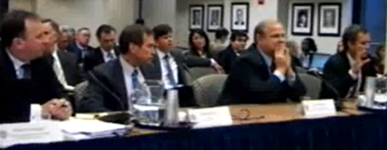
Lionsgate was the rare studio publicly supporting box office futures, and HSX co-founder Michael Burns was now Vice-Chair of the studio. Burns would testify in favor of them at the CFTC hearing on May 19, 2010.
Meanwhile, the other HSX co-founder, Max Keiser, opposed the Cantor Exchange’s efforts from the beginning, comparing it to Enron:
The potential for mischief with Cantor’s new box office futures contracts is enormous (“All eyes on Hollywood futures”, December 13). When I was running the Hollywood Stock Exchange during the 1990s I was constantly approached by the Hollywood studios asking me to move up the prices of their MovieStocks to influence the perception of their films in the weeks just before a movie was released at the box office.
I believe that when these box office futures contracts become available these same studios will redirect millions of dollars they spend on marketing to buy and sell futures contracts in order to drive the price, and therefore perception, of their own and competing studios’ films, higher or lower.
Perception is the currency in Hollywood, and pricing perception, while putting the price discovery mechanism for perception into the hands of the same hedge fund and futures trading industry that has, by and large, been responsible for the mess the global financial system now finds itself in, portends a new kind of disaster film none of us wants to see.
How long before taxpayers in the US will be asked to bail out the Hollywood studios after they have bankrupted themselves making risky futures bets trying to influence the perception of their own and other studios’ films? Does the US really need a new way to destabilise its economy with more dodgy derivatives? I think I have seen this movie before. It was called Enron.
After Enron, Hollywood bets on its own script for future profits
The millions of dollars Hollywood annually spends on lobbying would pay off:
Cantor Fitzgerald may be a big deal on Wall Street. But it doesn’t have nearly as much pull on the Hill. It hasn’t lobbied the Senate directly since 2002, according to disclosure databases. And while its employees give generously to congressional candidates, it doesn’t have a PAC exclusively promoting its interests. MDEX—an Arizona-based firm started in 2007—is even less of a Washington player.
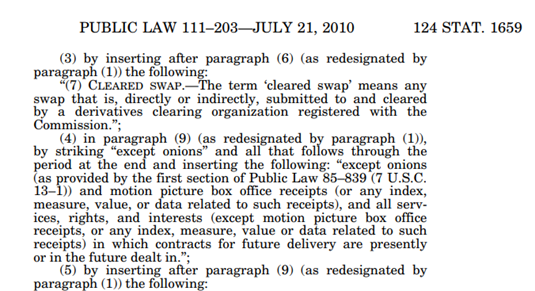
Hollywood’s lobbying paid off. On April 16, as MDEX executives were no doubt celebrating their good fortune, Sen. Blanche Lincoln (D-Ark.) released her draft financial regulatory reform bill. In it, she proposed the first exclusion of a product from futures markets since angry onion farmers descended on Congress in 1958 to accuse Chicago-based traders of capturing the market and artificially driving down prices. The current law lays out rules governing the trade of derivatives of any product “except onions.” If Lincoln’s bill passes, it will read “except onions and motion picture box office receipts (or any index, measure, value, or data related to such receipts).”
Hollywood’s Big Wall Street Smackdown

During the 2010 House Agriculture Committee hearing on motion picture box office futures, Pisano and Scott Harbinson, a Hollywood union representative, directly compared movie futures to behavior leading to the 2008 financial crisis and skepticism of Wall Street. Harbinson would bluntly state during the Congressional hearing:
Well, I am a little different than the rest of the panelists. I am a working person that represents working men and women, so I bring a different perspective to this. But from the perspective of the people I represent, it looks very much like the Wall Street guys are trying to do for the motion picture industry what they did for the real estate and mortgage banking industry, and we don’t want it. We don’t want any part of it. It has been very well articulated by the MPAA, it has been articulated by us, and it has been articulated by the independent producers. And I am hoping that the Committee sees it that way and realizes that all this is gambling for a select few to make money at the expense of those of us who make motion pictures.
Movie Futures Congressional hearing transcript
Hollywood’s lobbying of Congress quickly worked. Senator Blanche Lincoln from Arkansas inserted text into the 2010 Dodd-Frank Act (sponsored in the House by Barney Frank) amending the Commodities Exchange Act (CEA) to specifically ban film futures. This would be only the second product banned from futures trading after onions in 1958.
The amendment to Dodd-Frank even took some at the CFTC by surprise:
The second dissenting vote on the CFTC commission was Jill Sommers, who served for six years under presidents George W. Bush and Barack Obama. Now a senior adviser at Patomak Global Partners, Sommers told me it was a real surprise to the commission that the amendment ended up in Dodd-Frank. “This really didn’t have anything to do with the financial crisis,” she said. “It kind of took the decision out of our hands in the end.”
Box Office Bomb: The Short Life of Popcorn Prediction Markets
And the updated code applied retroactively to two box office futures contracts already approved by the CFTC. Both Takers (approved June 14) and The Expendables (June 28) would not be exempted from the law.
“It was just a simple Hollywood handout,” Jaycobs told TheWrap in June. “They just thought they’d stick it into the bill, and it would be innocuous.’”
“She didn’t know the facts of the situation,” added Swagger, who was called into meet with Lincoln and her staff after blasting the Congresswoman in the press.
Swagger said the meeting went well — he was able to make the case that movie derivatives were nothing like the infamous credit default swaps they were being erroneously compared to. “Her chief of staff said he wished they’d never put it in the bill in the first place,” he explained.
But Lincoln couldn’t take it back. “By the time Blanche Lincoln realized what she had done, movie futures had already become the poster child for everything that had gone wrong on Wall Street,” Swagger said.
That’s not to say that Jaycobs and Swagger didn’t try to get the ban lifted out of the bill. Meeting individually with more than 100 members of the House, the executives pleaded for more time and dialogue.
Empathetic lawmakers told the executives that they’d like to help. But facts and nuances be damned, fancy new financial products of any kind were, in the words of one lawmaker, the political equivalent of “nuclear waste” on Capitol Hill. Meanwhile, dissonant themselves to the overall reform bill, Congressional Republicans told Cantor and Media Derivatives executives merely to “get in line” with their other unhappy constituents.
The Rise & Plunge of Movie Futures Trading
Note that Lincoln was not as ignorant of Hollywood as Swagger implies. Her sister Mary Lambert was a successful Hollywood director, responsible for the original Pet Sematary film and several iconic music videos from the 1980s (including “Material Girl” and “Like a Prayer”).
The same day Cantor Exchange received CFTC approval for its first box office futures contract, June 28, it was already waving a white flag in defeat. After the exclusion language was included in the final version of Dodd-Frank, passed by the House on June 30, but before the Senate even voted, Cantor Fitzgerald laid off four of the last five members of the HSX team on July 1. The value of HSX to the company wasn’t for its bottom line, but to develop a real-money box office futures exchange. And with that out of the picture, the inevitable downsizing occurred.
When all was said and done, Robert Swagger claims that Media Derivatives spent $30 million on navigating the legal and regulatory process for TrendEx, only to receive approval and then have box office futures banned entirely.

Where are they now?
HSX still lives on today, albeit very diminished from its peak decades ago, with thousands of traders still buying and selling movie stocks every day. “The community outlived the brand,” as Brian Dearth describes it. Cantor Exchange was split into FMX Futures Exchange, to compete with the CME on U.S. Treasury and interest rate futures, and CX Markets, which hosts weather futures. Howard Lutnick is the U.S. Secretary of Commerce. Brian Dearth founded Bravo Digital Partners. Ben Curtis served as CTO of Chess.com. Paul Anderson is General Counsel at Barstool Sports. Dan Glickman retired from the CME Board earlier this year and is an adjunct professor at Tufts University. Gary Gensler served as Chairman of the SEC from 2021-2025. Jill Sommers served on the FTX Board of Directors and was recently considered by President Trump for the CFTC Chairmanship. Blanche Lincoln lost re-election in 2010 and currently lobbies for Kalshi. Rich Jaycobs consults with prediction markets seeking CFTC approval. Andy Wing over the last decade has been, and is currently, Chairman of Interpret, Global Entertainment & Sports Insights firm. Michael Burns has served for over 25 years as Vice Chairman of Lionsgate film studio. Max Keiser is currently Senior Bitcoin adviser to President Bukele of El Salvador. Robert Pisano never became the permanent head of the MPAA and was succeeded by Connecticut Senator Chris Dodd, namesake of the 2010 Dodd-Frank Act.
Why does this matter today?
First, HSX built a community that survives after thirty years despite no marketing or dedicated paid staff today. Many of the new prediction markets, particularly in the crypto space, can learn from their “user-centric” approach.
Second, regulatory risk is important. HSX/Cantor Futures played by the rules, spent years going through the CFTC process to become a DCM, only to have the rug pulled out from under them after they crossed the finish line.
The MPAA only spent around $2 million per year on federal lobbying when it quickly crushed box office futures in 2010.
In its four-year history, Kalshi has only spent $1.55 million on lobbying in D.C., of which roughly half was spent in 2024. Polymarket doesn’t show any lobbying expenditures until 2025, and so far, that is only a measly $270,000.
The Gambling Lobby spent $39.2 million in 2024 alone, paid to 321 lobbyists, of whom 56% are former government employees. And this is merely lobbying at the federal level. Despite their public proclamations of disinterest, the success of Kalshi and Polymarket is already having an impact on the gaming companies’ stock prices. A multibillion-dollar industry is not going to passively watch while its business model is being disrupted. Particularly one dependent on regulatory barriers to entry.
Prediction markets can make it through the CFTC approval process and survive numerous court challenges, only to be killed off because of one powerful politician inserting language into a complex piece of legislation. Today, that is not feasible because of a House, Senate, and White House all being favorable to prediction markets and other types of financial innovation. But this will not last forever, and eventually the pendulum of U.S. politics will swing back in the other direction.
Further Reading & Viewing
Hollywood Stock Exchange
HSX Glossary
History of HSX
HSX Research Corporate Overview
Max Keiser on CNBC HSX Interview (1996)
Take Stock In Hollywood, Just For Fun (March 29, 1996)
‘Highway’ pic listed on H’wood Stock Exchange (December 2, 1996)
The Hollywood Stock Market: You Can’t Lose (January 11, 1998)
Studios deny ‘Access’ (November 7, 1999)
Max Keiser of HSX on Silicon Spin (1999)
Architecture With Star Quality (October 31, 2000)
The Power of Play: Efficiency and Forecast Accuracy in Web Market Games (February 9, 2001)
The HSX Entertainment Community (March 2001)
Another Meaning for ‘Film Short’ (August 7, 2001)
Stock Up on Hollywood (October 22, 2001)
Extracting Collective Probabilistic Forecasts from Web Games (2001)
Video: Chilton Says CFTC Likely to Vote on Movie Futures Today (March 23, 2023)
Internet-Based Virtual Stock Markets for Business Forecasting (October 2003)
It’s Just a Game, but Hollywood Is Paying Attention (November 23, 2003)
Simply Efficient Markets and the Role of Regulation: Lessons from the Iowa Electronic Markets and the Hollywood Stock Exchange (2003)
Why the Hollywood Stock Exchange was sold to Cantor Fitzgerald. – An insiders account
(February 23, 2007)
Press Release: CANTOR ENTERTAINMENT TO ANNOUNCE MOVIE BOX OFFICE CONTRACTS (December 8, 2008)
All eyes on Hollywood futures (December 12, 2008)
After Enron, Hollywood bets on its own script for future profits (December 20, 2008)
“Incentive and Accuracy Issues in Movie Prediction Markets” (2008)
Cantor Exchange CFTC Filings (2010)
Cantor Exchange Expecting CFTC Approval; On Track to Launch April 20 (February 22, 2010)
Media Derivatives, Inc. Rulebook (March 16, 2010)
Pisano letter to Gensler (March 23, 2010)
Cantor Futures Exchange Rule Submission (March 30, 2010)
New Opposition to Movie Futures Trading: Congress (April 6, 2010)
MPAA Chief Bob Pisano Lays Out Case For Market Manipulation In B.O. Futures Trading (April 16, 2010)
Video: CSPAN coverage of Movie Futures Congressional hearing (April 22, 2010)
Movie Futures Congressional hearing transcript (April 22, 2010)
Summary of Testimony of Schuyler Moore & “Betting the Box” article (April 22, 2010)
Hollywood’s Big Wall Street Smackdown (April 26, 2010)
Video: CFTC hearing on box office futures (May 19, 2010)
Testimony of Richard Jaycobs, President, Cantor Futures Exchange to the CFTC (May 19, 2010)
Statement of A. Robert Pisano Interim CEO MPAA (May 19, 2010)
CFTC Approves Box Office Receipt Contracts Submitted by Media Derivatives (June 14, 2010)
Opening bid on film futures (June 15, 2010)
Video: Swagger Discusses Contracts Tied to Box-Office Receipts (June 18, 2010)
DCM Product: Opening Weekend Motion Picture Revenue Contract (Takers)
DCM Product: The Expendables Domestic Box Office Receipts
Cantor Exchange Backs Away From Hollywood (June 28, 2010)
Cantor Fitzgerald’s HSX Lays Off Its Staff (Updated) (July 1, 2010)
Media Derivatives Chief Going Abroad With Movie Futures Trading (August 2, 2010)
HSX to Live On, Cantor Insider Says (August 13, 2010)
10 Key Moments in the Life of Movie Derivatives (August 13, 2010)
The Rise & Plunge of Movie Futures Trading (August 15, 2010)
Back to the Future(s): A Critical Look at the Film Futures Ban (April 26, 2011)
A Cross-sectional Analysis of the Hollywood Stock Exchange’s Forecasting Accuracy and Risk vs. Return Relationships (2013)
Box Office Bomb: The Short Life of Popcorn Prediction Markets (November 15, 2018)
Google Scholar: “Hollywood Stock Exchange”