U.S. Navy sailors betting bottles of booze to help locate a lost submarine might be the greatest sea tale in the entire history of the U.S. Navy.
This (true) anecdote was popularized by James Surowiecki’s book The Wisdom of Crowds (2004), which cites a passage from Blind Man’s Bluff: The Untold Story Of American Submarine Espionage (1988) by Sherry Sontag, Christopher Drew, and Annette Lawrence Drew. Below we’re drawing mostly from Blind Man’s Bluff and a 1971 paper “Operations Analysis During the Underwater Search for Scorpion” by Henry (“Tony”) Russell Richardson III and Lawrence (“Larry”) D. Stone (who were both on the actual search team) to piece together how a U.S. Navy search harnessed the ‘Wisdom of Crowds’ to help locate a lost submarine.
The U.S.S. Scorpion was a nuclear-powered submarine that disappeared in late May 1968 somewhere in the Atlantic Ocean. By June 5, the sub and its 99 crew members were presumed lost at sea, and a search team was assembled. The search would be led by John P. Craven, Chief Scientist of the Navy’s Special Projects Office.
Palomares Incident
A few years earlier, Craven had previously led the search for an H-bomb lost in the Mediterranean Sea from an aircraft accident in 1966. According to Craven, the timing of the search for the missing thermonuclear weapon was fortuitous:
A few weeks earlier, I had attended a lecture by Professor Howard Raiffa of Harvard on the esoteric subject of Bayes’s subjective probability. The lecture itself was not esoteric at all. It was based on Raiffa’s experiences at the racetrack. He noted that the betting odds on horses were determined by the bets placed by bettors before the start of the race. After much research, he discovered that bettors accurately predict the odds on a horse winning a race. Six-to-one-odds horses won once every six times. One-hundred-to-one-odds horses won once every hundred times. Even-odds-on horses won half the time and so on. Based on these odds he could successfully predict the correct odds not only for win but for place and show—the horses that would finish second or third, respectively—through the mathematics of probability. The probability equations were developed by Thomas Bayes centuries earlier, but the concept as applied to operational analysis and game theory was Raiffa’s brainchild.
…
My colleague and I plotted the probable location of the bomb for each scenario together with the probable dispersion area around that location. Employing an assorted number of experts, we bet on the most probable scenario. [emphasis added] Then we plotted weighted probability distributions, added them together and adjusted the total field of probability to make the total probability that the bomb was somewhere in Palomares waters equal to one.
We immediately sent this probability map to the commander in the field with instructions to search in the areas of highest probability. It was continuously modified on the basis of the searches that were conducted.
Silent War, pp.167-168
Craven and the assembled experts bet alcohol on various scenarios, believing that putting something tangible at stake created better estimates. The missing bomb was located after an 80-day search, and Craven became instrumental in promoting Bayesian search theory within the Navy.
The Search for Scorpion
In 1968, submarines rarely communicated on missions, so radio silence from the Scorpion was not out of the ordinary. Not until the submarine was expected to dock in Norfolk, Virginia, with families waiting to greet their fathers, sons, and husbands, that the Navy realize it was missing. (INFORMS History Interview with Larry Stone)
A search for a missing submarine somewhere in the Atlantic would be much more complicated than an undetonated bomb falling into the ocean.
After the emergency search phase [unsuccessfully searching above water for survivors and debris] which stretched across the Atlantic Ocean, the search effort was confined to an area located approximately 400 miles southwest of the Azores.
…
a conference was held July 18 where Dr. J. P. Craven and Dr. F. A. Andrews postulated nine scenarios concerning the events attending the disaster and assigned credences to them. These were then converted…to individual a priori probability distributions of the location of Scorpion corresponding to the respective scenarios, and these were combined as an average weighted by the assigned credences to obtain the overall distribution. Craven had earlier originated this approach in the H-bomb search. The calculations were performed by monte-carlo procedures.
“Operations Analysis During the Underwater Search for Scorpion”
Interestingly, there is no mention of wagering in Richardson & Stone’s account of the search. Tony Richardson passed away in 2023. Larry Stone doesn’t recall any bets placed on the scenarios or alcohol being wagered but acknowledges it could have taken place before he and Richardson arrived. (Larry Stone email to author, July 31, 2025)
Here is the Blind Man’s Bluff version of the estimates being generated:
Few of the officers involved in the search for Scorpion had taken much note of Palomares. And by the time Craven was finished explaining that he was going to use a system of Las Vegas-style bets to factor the value of a hunch into his data, some of the operational commanders were convinced that he had gone completely over the edge (emphasis added).To them, it sounded like he was talking about ESP. Craven once again tried to explain that Bayes seemed to draw on the knowledge that even experts are not always consciously aware they have. The commanders remained highly skeptical.
Still, Craven pushed on, asking a group of submarine and salvage experts to bet on the probability of each of the different scenarios being considered to explain Scorpion’s loss. To keep the process interesting, and in line with previous wagers, the men bet bottles of Chivas Regal (emphasis added).
Scorpion could have glided down to the ocean bottom at speeds between 30 and 60 knots. His submarine experts bet that Scorpion had glided downward at between 40 and 45 knots.
Next, the experts were asked to bet on whether they believed Scorpion was trying to shut down a hot-running torpedo and was therefore traveling east. About 60 percent of the bets favored the torpedo theory. Craven, it seems, was winning some converts.
In a third round of betting, the experts picked a glide path. At the most, Scorpion could have moved 7 feet forward for every foot she descended; at the least, she could have nosedived straight down. The bets favored a glide path of about 3 or 4 feet forward for every foot down. That meant Scorpion would have traveled 6 to 8 miles after the first explosion.
Blind Man’s Bluff, pp.104-106
Craven’s son David questions the betting story presented in Blind Man’s Bluff, not because the experts didn’t bet with liquor, but because his father didn’t care for blended scotch like Chivas Regal. David Craven is “pretty certain that they were betting bottles of Champagne for the H-Bomb and Lafroig (or some other good single malt scotch) for the Scorpion.” (David Craven email to author, July 17, 2025)
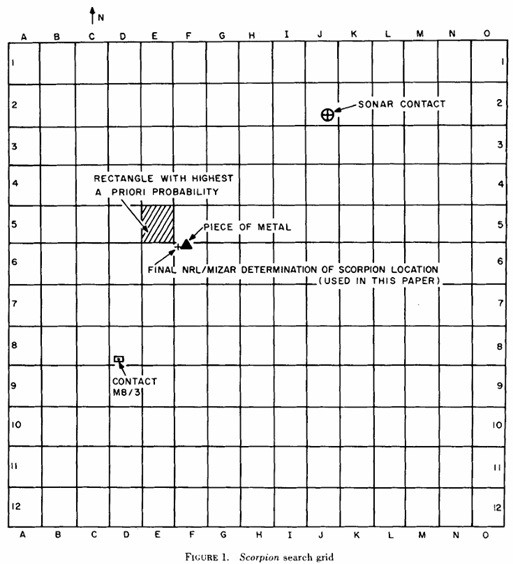
In order to allocate search effort effectively, the search grid shown in Figure 1 [above] was established. The cells are 1 mile in the north-south direction and 0.84 miles in the east-west direction.
…
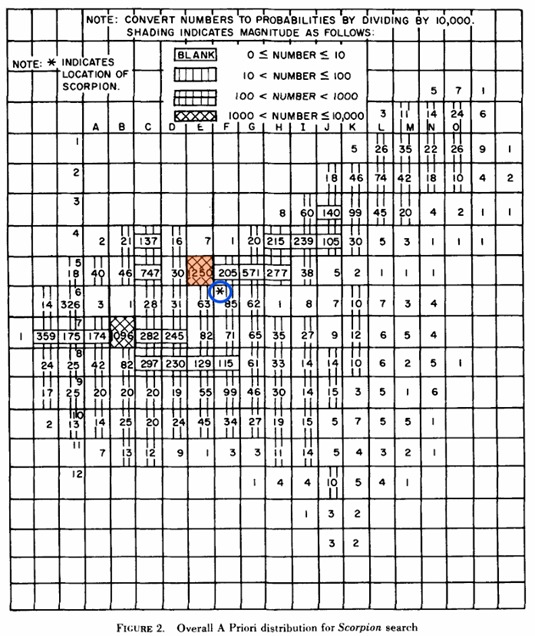
The credence (a number between zero and one) associated with each scenario reflected the scenario’s plausibility relative to the others and incorporated (at least indirectly as interpreted by Craven and Andrews) the views and opinions of Navy operating personnel as well as the analysis of specialists in many scientific areas. The monte-carlo computer program for generating the probability map begins a replication by causing a random number to be drawn in order to determine the choice of scenario. The scenarios are selected with frequency specified by the assigned credences. The movement of the submarine as specified by the selected scenario is then simulated with random numbers drawn as required to represent the uncertainties in course, speed, and position, at the time the emergency occurred, as well as other variables. The final position of Scorpion is deter- mined and the output of the replication is a “one” added to the appropriate search cell. The result of 10,000 replications is shown in Figure 2 [below].
“Operations Analysis During the Underwater Search for Scorpion”
For clarity, the cell with the highest prior probability is highlighted in red, and the actual location (*) is circled in blue:
Searching June 10 to October 28, 1968
The USNS Mizar was a naval research ship commissioned in 1961 that had been used in the search for the lost submarine USS Thresher in 1963 and the missing nuclear weapon in 1966, and was the vessel chosen to undertake the search for the Scorpion.
The search equipment consisted of a towed platform (called the sled) upon which were mounted cameras, magnetometers, and sonars. This platform operated as much as 2 miles below the surface of the ocean, creating difficult maneuverability problems.
The visual sensors consisted of wide angle lens cameras some of which could be loaded with enough film to take pictures every 30 seconds for as long as 30 hours.
The magnetometer which was employed throughout the search was a proton precession type which measured the strength, but not the direction of the magnetic field. It, too, was activated by a signal from Mizar. Despite the uneven magnetic background in the search area, the magnetometer was the first sensor to detect Scorpion.
Two different side-looking sonars were used during the search. One of these could be used in either short range or long range mode; the short range mode providing the higher resolution. This was the sonar which was used at the beginning of the search and was replaced by the second sonar after August 4. The latter sonar operated in a single mode.
…
When coded transponders were available, a computer-transponder system could be used to calculate the position of the ship and sled. This system consisted of coded transponders anchored to the bottom, three transceivers mounted in the hull of Mizar, and a responder located on the sled which carried the search sensors. The coding of the transponders allowed Mizar to interrogate a particular transponder without interrogating the entire field of them.
Because of the efficiency associated with long sweeps, the piece of metal found early in the search, and other reasons, search effort was never assigned solely to cell E5, even when it was the current (a posteriori) high probability cell. Rather, search effort was assigned to the general vicinity of E5 with large amounts placed in neighboring cells, including F6.
…
The search phases can be conveniently described in terms of Mizar’s five cruises: (1) June 10-28, (2) July 10-August 6, (3) August 14-September 8, (4) September 20-October 7, and (5) October 16-November 2. These are dates out of the Azores which were 1.5 days sailing from the search scene.
“Operations Analysis During the Underwater Search for Scorpion”
The search grid probabilities were not available until the third cruise, which started on August 14, and the Navy located the sunken sub on October 28. If we take the 57 total search days and subtract the 3 days from each cruise to account for sailing between the Azores and the search scene, then it took roughly 48 days to find the Scorpion after the Navy began using the probability density grid.
The Scorpion was found roughly 260 yards from the cell with the highest prior probability (the red cell in the above grid).
Further Reading
“40th Anniversary of Palomares”
Blind Man’s Bluff: The Untold Story Of American Submarine Espionage, pp.104-106
Building a Successful Company – With Mathematicians???
“Frank Andrews Obituary”
“Henry Russell Richardson III, 84, of Williamsburg” Obituary
INFORMS History Interview with Larry Stone
“John P. Craven, scientist who directed top-secret Navy projects, dies at 90”
“John Piña Craven, American Treasure”
“Operations analysis during the underwater search for Scorpion” by Richardson & Stone
“Real Story of Scorpion?”
“Search Theory” by Henry R. Richardson
“Searching for the Thresher” by Frank A. Andrews
The Silent War: The Cold War Battle Beneath the Sea by John P. Craven
Theory of Optimal Search by Lawrence D. Stone.
The Wisdom of Crowds, pp. XX-XXI